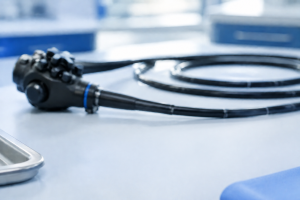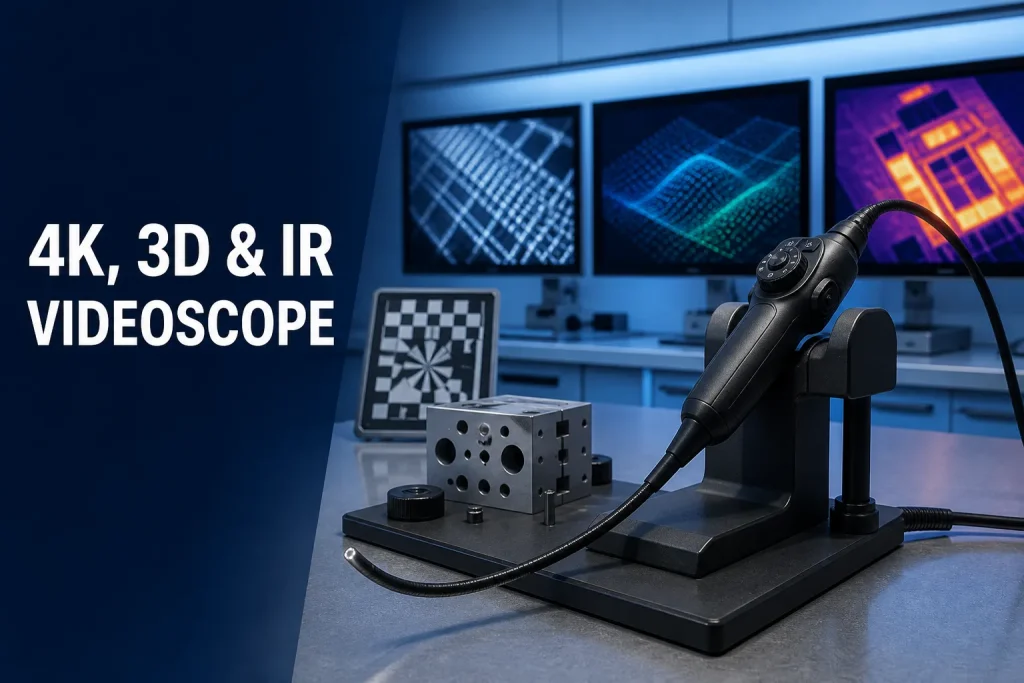
On August 20, 2026, Olympus announced a flexible-tip videoscope designed to support 4K, 3D and infrared imaging in surgical environments. The launch is significant not because every repair center will service that product, but because it illustrates a wider engineering direction: one scope may participate in several imaging modes, each dependent on a controlled optical, electronic and system configuration.
The factual product statements in this article come from Olympus’s official announcement. The discussion of repair-bench consequences is an engineering interpretation, not Olympus service guidance, a compatibility claim or an indication that Endopart supplies parts for the announced device.
What Olympus Announced
Olympus described a flexible-tip videoscope supporting 4K, 3D and IR imaging. According to the company, the product is intended to combine flexible observation with multiple visualization capabilities. Availability, compatible systems and exact specifications must be checked in the official regional product information and manufacturer documentation.
These capabilities differ from the June 2026 Olympus announcement about new 4K LCD monitors. A monitor affects the display end of the chain; a multi-mode videoscope adds questions about image acquisition, optical paths, mode selection and system communication. Repair teams should not merge the two announcements into one generic “higher resolution” story.
Why Multiple Imaging Modes Change the Test Question
A conventional pass/fail note such as “image clear” becomes even less useful when a device supports several modes. A scope could appear normal in one configuration while a mode-dependent function is unavailable or unstable. Verification must identify the mode, processor, light source, display, cables, software context and test target.
This does not mean independent repair centers should invent tests for a new product. It means they should review whether their current records are capable of distinguishing white-light, 3D, IR and display-path observations whenever manufacturer procedures require those checks.
4K Resolution and Source-Image Quality
4K describes a high-resolution image or display format, but a sharp displayed image depends on the full chain. Distal optical condition, imaging sensor performance, signal transmission, processor settings, external cables and display scaling all contribute. A 4K label cannot identify the location of a fault.
Repair benches need stable targets, controlled working distance and documented enhancement settings. A higher-detail image may reveal dust, nonuniformity, noise or focus limitations that were less visible on an older station. It can also make harmless display artifacts appear more significant unless compared with a known-good approved reference.
3D Imaging Adds Paired-Channel Considerations
Three-dimensional endoscopic imaging commonly depends on coordinated image information and system processing. The exact design of the announced scope belongs to the manufacturer and should not be inferred from marketing images. From a repair-quality perspective, the general lesson is that paired or coordinated channels require verification of balance and synchronization under the specified procedure.
A technician should avoid diagnosing “one bad camera” from a flat monitor view without model-specific evidence. Processor configuration, display mode, cable path or calibration can contribute to an apparent mismatch. Only approved diagnostics can identify the responsible region.
IR Imaging Requires Mode-Specific Control
Infrared imaging uses different illumination and detection conditions from ordinary visible-light observation. A surface that appears clean under room light can behave differently in another spectral mode, while source filters, optical transmission and processor settings may affect performance. The manufacturer’s test method and safety requirements are essential.
Independent repair articles should not publish invented IR output limits or claim that a generic lens, bundle or tube is suitable. Parts compatibility and optical performance must be verified for the exact model and mode.
A Multi-Mode Fault Tree
The first branch should ask whether the symptom occurs in every mode or only one. A failure common to all modes may involve shared system elements; a mode-specific failure narrows the investigation but does not automatically identify a component. Next determine whether the fault follows the videoscope, processor, source, cable or display through one-variable substitution.
Configuration Data Worth Recording
- Videoscope model, serial or controlled asset reference.
- Processor, light source, display and cable configuration.
- Selected imaging mode and relevant approved settings.
- Warm-up time, target, working distance and ambient conditions.
- Whether the symptom follows the scope during substitution.
- Position, movement and elapsed time associated with the event.
Optical Components Need Functional Context
Products such as a light guide lens, light guide bundle or protective tube have roles within specific designs. Visual similarity does not establish their spectral transmission, geometry, material or compatibility with a multi-mode system.
When an illumination fault is isolated, inspect and measure according to controlled documentation. Do not use the 2026 announcement as a basis for claiming that an existing generic optical component supports 4K, 3D or IR.
Flexible-Tip Mechanics Still Matter
The phrase “flexible-tip” highlights the relationship between imaging capability and mechanical positioning. Angulation response, neutral return, external covering condition and strain transitions can affect how a scope is used and how intermittent faults appear. Mechanical and image verification should remain separate but correlated.
A fault that appears only during permitted tip movement requires controlled positional testing. Aggressive bending can worsen damage and does not substitute for the manufacturer’s diagnostic procedure.
Test Targets May Need More Than One Purpose
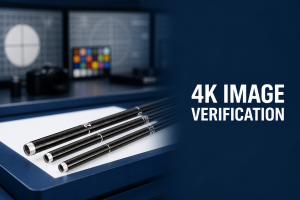
A white-light target can support checks of focus, field, color and uniformity but may not verify 3D or IR functions. Repair organizations should use only targets and fixtures required or approved for their capability. They should identify which characteristic each target evaluates rather than treating one image as proof of all functions.
Target condition matters. Faded color patches, scratched surfaces, uneven lighting or incorrect distance can create false differences. Control the target as inspection equipment when the quality system requires it.
Software and Configuration Become Part of Traceability
Modern imaging platforms may use software settings, licenses, calibration data or connected functions. A repair record should capture relevant versions and configurations when the manufacturer’s procedure identifies them. A physical repair may appear unsuccessful if the station is configured incorrectly.
Cybersecurity, access rights and data handling should follow manufacturer requirements, contracts and applicable regulations. Technicians should not bypass controls or install unofficial software to obtain a test mode.
Incoming Inspection of Imaging-Related Parts
Appearance remains only one inspection layer. Incoming parts should retain supplier, item and lot identity; optical surfaces need protection from contamination and scratching; electronic assemblies need handling controls appropriate to their design. Functional evaluation should use an approved fixture or designated non-clinical test device.
A sample that performs in one mode or model does not prove broad compatibility. Record the exact configuration and limit approval to the item and application actually evaluated.
Post-Repair Verification Should Challenge the Complaint
If the original complaint is mode-specific, repeat that mode under the same approved conditions after repair. Also complete shared baseline checks and every safety or mechanical verification required by the manufacturer. A normal white-light image cannot automatically close an IR complaint.
For intermittent symptoms, reproduce the same movement, duration and temperature conditions without exceeding limits. Record negative findings with cycle count and observation time.
Implications for Training
Technicians need system-level reasoning more than memorized failure pictures. Training should ask them to distinguish scope, source, processor, cable and display effects; identify the active mode; and choose the next discriminating test. Competency review should evaluate the evidence trail, not only the final answer.
Organizations should define when a device exceeds their validated capability and requires manufacturer or specialist escalation. New technology does not expand authorization automatically.
Service Equipment Qualification
Multi-mode scopes may require processors, sources, monitors, calibration tools and fixtures that are not present on a conventional flexible-endoscope bench. Before accepting repair work, the organization should confirm that each required item is approved, maintained and available for the complete verification sequence. Owning a compatible connector is not equivalent to having a validated test capability.
Equipment qualification should include configuration control and periodic checks. If a test station is updated, repair personnel should determine whether baselines, work instructions or acceptance records need revision.
Failure Reporting and Escalation
When an unusual mode-dependent event may relate to safety or product performance, preserve logs, configuration data and the device condition according to organizational procedures. Do not repeatedly stress the scope to obtain a more dramatic recording. Escalate to the manufacturer, authorized service channel or regulatory process when required.
Describe observations without claiming a root cause that has not been confirmed. Exact model, mode, system configuration and reproducibility are more useful than broad statements such as “IR failed.”
Inventory Boundaries for New Platforms
A new platform can create pressure to cross-reference existing stock quickly. Resist assigning compatibility from dimensions or photographs alone. Separate evaluation samples from approved inventory, retain lot identity and require controlled verification before a product code is linked to a model.
If a supplier cannot provide adequate identity or technical information, the part should remain on hold. Marketing references to 4K or IR are not substitutes for documented form, fit, function and material requirements.
Long-Term Trend: More Configuration, Not Less Mechanics
Advanced imaging increases software and system complexity, but flexible portions, coverings, channels, strain relief and angulation mechanisms still operate under physical loads. Repair organizations need both disciplines: controlled digital configuration and precise mechanical workmanship.
The useful strategic response is not to abandon component-level expertise. It is to connect mechanical findings with mode-specific functional evidence and to maintain clear limits around which models and systems the organization can verify.
What Repair Managers Can Do Now
Repair managers can review current work orders before the new device reaches their bench. Confirm whether image complaints record the active mode and complete station, whether test equipment has controlled identifiers, and whether technicians distinguish observations from conclusions. Update forms only through the quality system and train staff on the reason for each new field.
They can also audit product cross-references for unsupported platform claims. Remove broad associations that rely only on appearance, retain evidence for approved model links and create a clear escalation route for unfamiliar multi-mode equipment.
Questions the Announcement Does Not Answer
Future technical updates may clarify some of these points, so conclusions should be revisited when official service information changes.
A public launch announcement does not provide a repair manual, internal architecture, parts catalog, acceptance limits or authorization policy. It also does not show that components used in earlier systems are interchangeable. Those questions require current manufacturer documentation and regional service information.
Responsible industry analysis should preserve that boundary. The announcement supports discussion of testing complexity and configuration traceability, but not speculative teardown diagrams or compatibility tables.
Implications for Parts Content and SEO
For technical suppliers, multi-mode platforms make precise product language more important. Articles should explain a component’s general repair role without claiming unverified platform support. Product pages should state measurable attributes and compatible models only when documented.
Broad phrases such as “4K endoscope parts” can mislead if they imply system compatibility. A better inquiry begins with the exact model, verified fault region, controlled part reference and test evidence.
Source and Interpretation Boundary
The primary source is the Olympus August 20, 2026 flexible-tip videoscope announcement, as listed in the company’s official 2026 news archive. Readers should consult the current official page for regional availability and product details.
All repair-testing recommendations in this article are general engineering inferences. They do not modify an Olympus IFU or service manual and do not establish third-party parts compatibility, authorization or regulatory status.
FAQ
Does the launch mean existing flexible endoscope parts support 4K, 3D and IR?
No. Compatibility must be established for the exact product, model and function. A general part category or visual match is not enough.
Can white-light testing verify an IR complaint?
Not necessarily. Follow the manufacturer’s mode-specific verification procedure and approved system configuration.
What should a repair record add for multi-mode imaging?
Record the active mode, complete system configuration, target, settings, conditions, symptom and substitution results.
Should an independent repair center service the new device?
Only if it has the required authorization, documentation, equipment, training and validated capability. Otherwise escalate appropriately.
Conclusion
That distinction protects technical accuracy.
The 2026 flexible-tip 4K, 3D and IR videoscope launch illustrates how endoscopy repair is becoming more system- and mode-dependent. Strong verification separates published product facts from assumptions, records the complete configuration and tests the original complaint under approved conditions. For a documented compatible-parts inquiry after fault isolation, contact Endopart with the exact model and technical evidence.