Uneven Endoscope Angulation: Isolating Cable Tension, Drum and Bending-Section Causes
Unequal up/down or left/right travel is often described as a “loose wire,” yet travel, return and control effort are system results. Cable condition, drum engagement, control-body friction, bending-section resistance, external covering and prior adjustment can produce overlapping symptoms. A useful diagnosis measures the pattern before changing tension.
This repair-engineering discussion is intended for qualified personnel. Follow the manufacturer’s current IFU, service documentation, validated fixtures, reprocessing controls and release criteria for the exact model. Stop work when the required authorization, specifications or test equipment are unavailable.
Capture the Original Angulation Pattern
Record maximum permitted travel in every direction with the same fixture, reference marks and observation method. Note control effort, free play, return toward neutral, hysteresis and whether the result changes after several cycles. Compare paired directions instead of evaluating one direction alone.
Inspect the exterior first. A crushed insertion tube, deformed distal section, damaged bending rubber or evidence of fluid invasion can make internal cable adjustment unsafe or misleading. Complete required leak testing before disassembly.
Separate Control-Side and Distal Resistance
Use the manufacturer’s isolation sequence to determine whether resistance originates near the control mechanism, along the cable path or in the bending section. Do not force a locked control. A cable can transmit motion while an adjacent structure limits final travel.
Observe when slack is taken up and when distal movement begins. Excessive dead band, abrupt movement and slow return are different evidence. A smooth but reduced arc may require a different investigation from a direction that jumps after free play.
Inspect Cable Evidence Without Presuming Failure
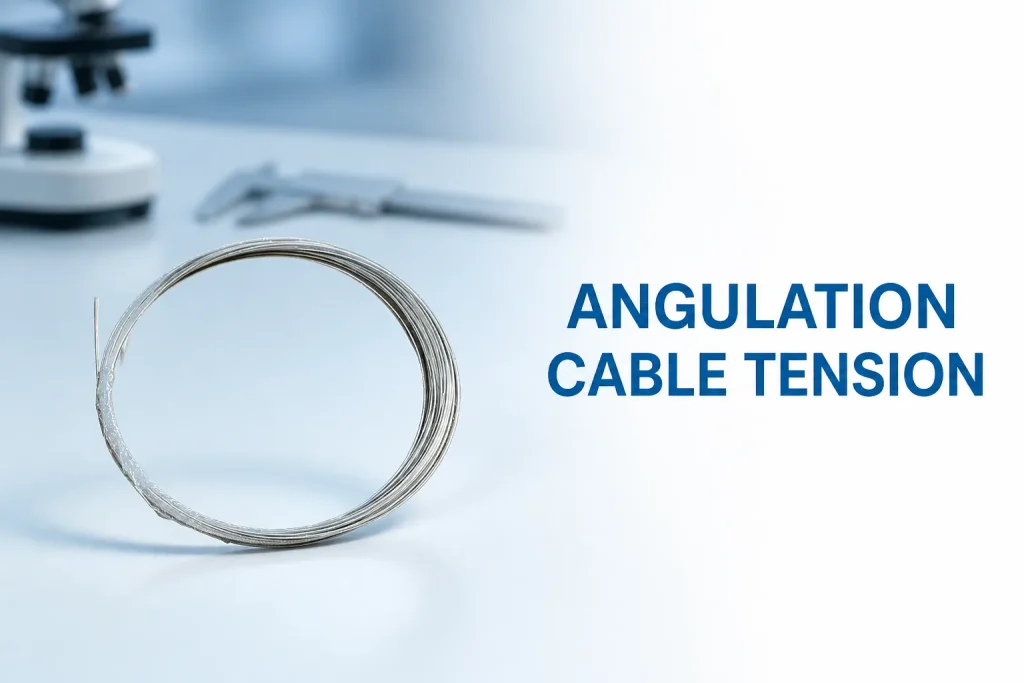
Where authorized, examine accessible cable surfaces and terminations under magnification for broken strands, corrosion, flattening, abrasion, displaced sleeves or abnormal attachment. A polished contact mark can locate rubbing but does not by itself prove replacement is required.
Compare paired cables using the approved method. Do not rely on finger feel or an improvised hanging weight. Tension values, datums and sequence are model-specific, and adjusting one direction can change the opposite direction and neutral position.
Evaluate the Drum and Control Mechanism
Check permitted drum surfaces, anchors, guides, brakes and knob interfaces for wear, looseness, contamination and lost motion. Mark original positions before disturbance. A cable adjusted to compensate for drum wear may temporarily improve travel while increasing load elsewhere.
Challenge the Bending Section
Inspect external shape and symmetry through the approved movement range. Local stiffness, uneven segment opening or a change tied to a particular arc can implicate bending-section resistance, mesh condition or covering interference. Do not expose or manipulate internal structures outside the service procedure.
Select Parts From Measured Evidence
When findings support the cable family, match the exact model, controlled length, termination style and documented application. The angulation cable product category provides a sourcing route, but photographs alone cannot establish compatibility.
Verify After Repair
Repeat travel, effort, free-play, return and cycling tests in all directions. Confirm knob locks and neutral behavior, then complete leak and functional tests required by the manufacturer. Record pre/post values and the installed part reference.
FAQ
Does reduced travel prove the cable is stretched?
No. Drum lost motion, distal resistance, covering interference and previous adjustment can produce the same observation.
Can one cable be tightened until the angles match?
Only through the model-specific sequence and limits. Uncontrolled tightening can overload the system and distort neutral position.
What should be supplied with an inquiry?
Exact model, direction affected, controlled measurements, cable reference where available, clear photographs and quantity.
Build a Direction-by-Direction Test Matrix
Create one row for each permitted direction and record control rotation, onset of distal motion, maximum travel, effort, return and repeatability. Add neutral photographs from the same camera position. This prevents a technician from improving one preferred direction while overlooking loss in its paired direction. If the model uses locks or friction controls, record their specified state and confirm that they fully release before comparing measurements.
Review Previous Repair Influence
Look for evidence of earlier adjustment, mixed cable references, disturbed anchors or nonstandard routing. Compare the incoming condition with prior service records when available. A scope that reaches the nominal angle only with abnormal control effort is not necessarily acceptable. Escalate any conflict between angle, effort and return criteria rather than selecting the most favorable result.
Control Assembly and Final Review
Before closure, exercise the mechanism slowly through the permitted range while observing accessible clearances. After closure, repeat the complete matrix because housing position can change friction or cable path. A second qualified reviewer should confirm that tension adjustment, part selection and the stated cause are supported by measurements. Preserve removed parts when the root cause is uncertain or supplier examination is planned.
Conclusion
A defensible repair decision connects a reproducible symptom to controlled observations, an isolated region and complete post-repair verification. It does not begin with a presumed failed part. For a documented compatible-parts inquiry, contact Endopart with the exact model, controlled reference, photographs and measured findings.