Loss of tip control is often described simply as an angulation problem, but that description does not identify the failed part. The same symptom can originate in an angulation cable, a pulley or control mechanism, the bending section, or several components at once. A disciplined diagnosis helps a repair center avoid replacing an expensive assembly when a smaller component is responsible—and avoids fitting a cable when the bending section still creates excessive resistance.
This guide presents a practical decision path for qualified flexible endoscope repair personnel. It is not a substitute for the model-specific service manual, inspection limits, or manufacturer instructions for use (IFU). Always isolate damaged equipment from clinical use and follow the applicable safety and reprocessing procedures.
Start With the Exact Angulation Symptom
Record the symptom before opening the control body. Useful observations include which direction is affected, whether travel is reduced or completely absent, whether control-knob resistance has increased, and whether the distal tip returns smoothly toward neutral. Compare all directions under the test conditions specified for that endoscope model.
A single weak direction can point toward a localized cable, attachment, or pulley-path issue. Reduced travel in several directions may indicate broader bending-section resistance, control-mechanism wear, or incorrect adjustment. A sudden change after impact should be handled differently from gradual loss of performance over many service cycles.
Do Not Diagnose by Knob Feel Alone
Control-knob feel is valuable, but it is not proof of a specific failure. Slack, drag, abrupt stops, or uneven movement must be correlated with visual inspection and model-approved measurements. Forcing a stiff control can worsen internal damage. Stop the examination if movement exceeds normal resistance or the manufacturer’s permitted range.
When the Angulation Cable Is the Main Suspect
Angulation cables transmit movement from the control mechanism to the distal bending structure. Possible cable-related indicators include increased free play, reduced movement in one direction, inconsistent response during repeated cycles, visible strand damage, deformation, corrosion, or a compromised termination. The exact construction and attachment method vary by model.
Inspect the entire accessible cable path and its terminations. A cable that appears intact in one exposed area may still be damaged elsewhere. Replacement selection should be based on the endoscope model, cable diameter, overall length, termination geometry, routing, and supplier documentation—not visual similarity alone. See Endopart’s angulation cable category for available compatible parts.
When to Inspect the Pulley and Control Mechanism
A sound cable cannot transmit motion correctly if its pulley path or control mechanism is worn, loose, contaminated, misaligned, or damaged. Look for abnormal groove wear, sharp edges, loose hardware, uneven tracking, or evidence that the cable has moved outside its intended path. Check related stops and brake functions only according to the service information for the specific model.
Repeated cable failure can be a clue that the surrounding mechanism is the root cause. Installing another cable without correcting a damaged pulley surface, alignment problem, or incorrect tension may shorten the life of the new part.
When the Bending Section Is Creating the Resistance
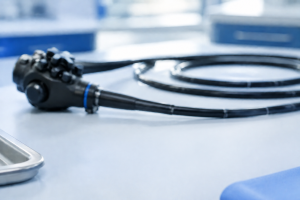
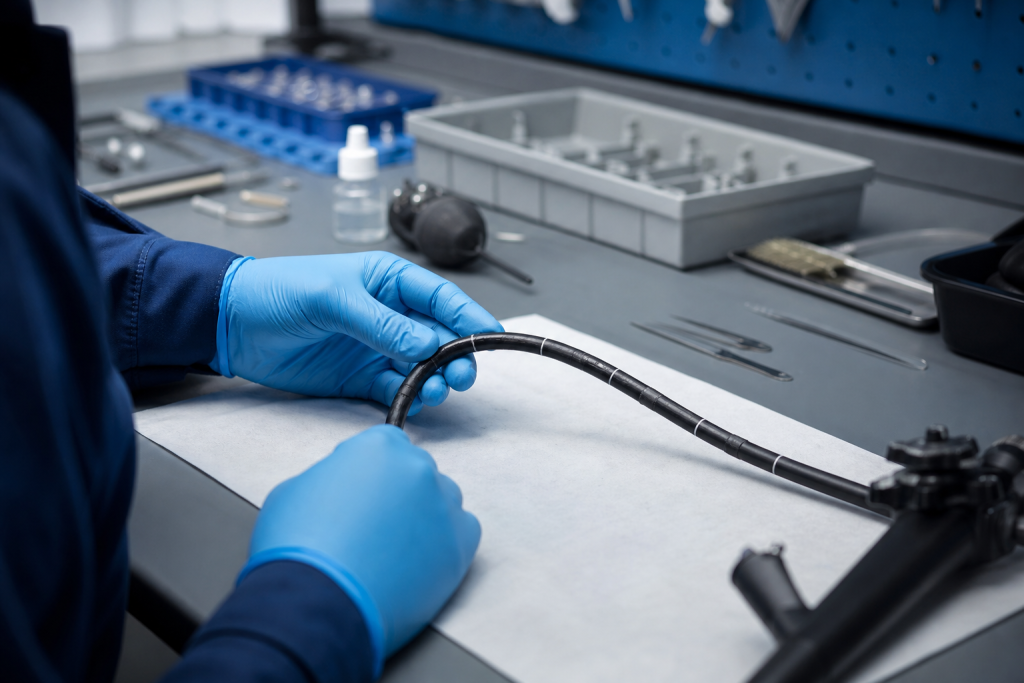
The bending section must articulate through a controlled curve while protecting internal channels and optical components. Deformation, crushed or displaced structural elements, external damage, or internal binding can increase the load required to move it. Inspect the bending area for asymmetry, localized flattening, unusual stiffness, or a curve that does not relax evenly.
Do not assume that a new cable will overcome mechanical resistance in a damaged bending section. Excessive tension can transfer stress to the cable, anchors, and control components. If the bending structure fails the model-specific inspection, evaluate the appropriate bending section or assembled replacement option.
A Practical Diagnostic Sequence
- Identify the affected direction and document range, free play, resistance, and return-to-neutral behavior.
- Check the exterior and bending area for impact, compression, buckling, or abnormal curvature.
- Inspect the accessible control mechanism, cable routing, pulley surfaces, attachments, and hardware.
- Separate transmission problems from bending-section resistance using only model-approved procedures and limits.
- Record findings and measurements before selecting replacement parts or making adjustments.
- After repair, complete all required functional, leak, safety, and reprocessing checks before release.
Information to Include in a Parts Inquiry
Provide the manufacturer and exact endoscope model, the affected direction, observed symptoms, measurements permitted by your procedure, and clear photographs of the original component and its terminations. If ordering a cable, include diameter, length, end geometry, and quantity. If several components are worn, ask whether matched parts or an assembly are available.
Use “compatible with” language for third-party replacement parts and verify fit before installation. Similar appearance does not establish compatibility, performance, or regulatory status.
Frequently Asked Questions
Can a loose angulation cable be adjusted instead of replaced?
That depends on the model, cable condition, attachment design, and manufacturer-approved service limits. Adjustment should never be used to compensate for fraying, corrosion, damaged terminations, pulley wear, or bending-section resistance.
Does stiff angulation always mean the bending section is damaged?
No. Stiffness can originate in the control mechanism, cable path, pulley system, or bending structure. The symptom must be isolated through a documented inspection.
What should be checked after an angulation repair?
Qualified personnel should complete the model-specific functional tests, verify smooth travel and neutral return, inspect cable routing and hardware, and perform all required leak, electrical-safety, reprocessing, and release checks in the applicable instructions.
Conclusion
Effective angulation diagnosis is a system-level task. The cable transmits force, the pulley and control mechanism guide it, and the bending section converts it into tip movement. Checking these elements in sequence reduces repeat failures and supports a more accurate parts order. For help matching a compatible component, contact Endopart with the model and measured specifications.
Reference: The U.S. FDA describes servicing as work intended to return a device to the safety and performance specifications established by the original equipment manufacturer. See FDA: Remanufacturing and Servicing Medical Devices.