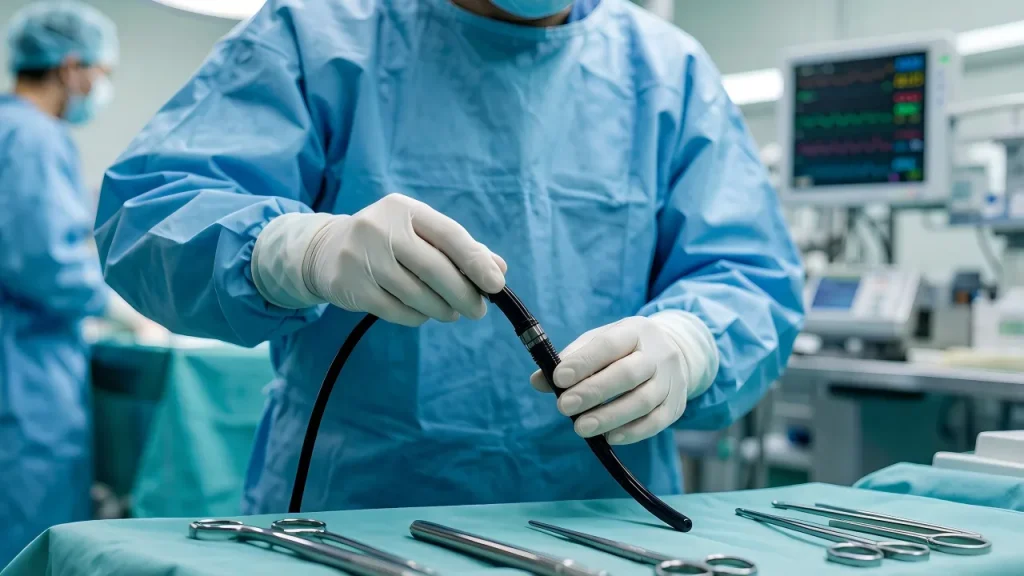
Visible Mechanical Deformation of Insertion Tube
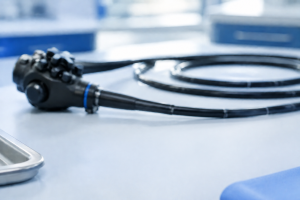
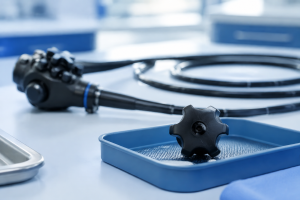
When the flexible endoscope insertion tube shows visible deformation, replacement is often no longer optional but a controlled risk decision. The core indicator is loss of structural roundness, surface cracking, or localized flattening that cannot recover after manual straightening. Once the outer sheath integrity is compromised, internal channel protection is already uncertain.
In real maintenance cycles, this is usually the earliest physical signal technicians notice. It looks minor. It isn’t.
A common blind spot in field servicing is treating surface wear as cosmetic. Based on past repair cases across Endo Parts supply chains, deformation often correlates with hidden internal wire fatigue.
Key observable signs:
- Flat spots along bending section
- Helical wrinkling near distal shaft
- Outer jacket micro-cracks under tension
- Persistent bending “memory” (tube does not return straight)
A quick field check:
- Roll tube on flat surface
- Observe bounce symmetry
- Check tactile stiffness variation
If it “wobbles” while rolling—stop using it. That’s structural failure starting.
Loss of Torque Response and Navigation Control
A flexible insertion tube that no longer transmits operator movement accurately is already functionally degraded. The core issue is loss of torque transmission efficiency, usually caused by broken coil layers or stretched internal reinforcement.
This failure mode does not appear suddenly. It creeps in.
Operators will notice delayed tip response, inconsistent angulation, or “soft zones” during navigation. That lag is not a user error—it is mechanical disconnection inside the tube structure.
Based on deployment feedback from service teams working with referenced maintenance benchmarks in high-volume hospitals, torque degradation is one of the most ignored pre-failure signals.
Typical symptoms include:
- Delayed distal tip reaction
- Uneven stiffness along shaft length
- “Spongy” feel during rotation
- Loss of precise loop control in tight anatomy
Comparison table helps clarify severity:
| Condition | Interpretation | Action |
|---|---|---|
| Slight delay in response | Early fatigue in coil layer | Monitor closely |
| Noticeable lag + uneven stiffness | Partial structural failure | Plan repair |
| No predictable control | Full torque failure | Replace insertion tube |
A common problem with many products on the market is that internal coil fatigue is masked until full navigation failure occurs. That is already too late for safe reuse.
Leakage, Insulation Breakdown, and Internal Failure Signs
Once leakage or insulation breakdown appears, the insertion tube is no longer a controlled sterile barrier. The internal waterproof layer integrity is compromised, and fluid ingress risk becomes operationally unacceptable in clinical environments.
This is not a gradual “maybe fixable” issue. It is binary. Either sealed, or exposed.
In practice, technicians often detect this during leak testing pressure drop anomalies, but subtle signs appear earlier if you know what to look for.
Key indicators:
- Unstable pressure retention during leak test
- Moisture traces near bending rubber
- Fogging inside optical field after reprocessing
- Intermittent electrical instability in active channels
A structured breakdown:
| Failure Type | Root Cause | Risk Level |
|---|---|---|
| Micro-leak at bending section | Rubber fatigue + repeated torque stress | Medium |
| Channel seepage | Internal sheath rupture | High |
| Full insulation breakdown | Multi-layer failure | Critical |
Based on past field data from service networks aligned with Endo Parts replacement cycles, leakage rarely remains localized. It spreads.
A blind spot that is often overlooked by engineers is assuming drying resolves fogging. It does not. It only hides moisture temporarily.
Once insulation is breached, replacement becomes the only predictable outcome.
Endoscopic Image Instability Caused by Tube Stress
Image instability is often misdiagnosed as processor or camera fault, but in many cases the root cause is mechanical stress transmission through the insertion tube, affecting distal optical alignment.
When the tube structure weakens, micro-vibrations amplify at the distal tip, producing unstable visualization even if the imaging system is fully functional.
This is especially common in high-use environments where torque fatigue accumulates gradually.
Symptoms include:
- Jittering image during minimal movement
- Loss of center alignment in straight insertion
- Intermittent blur under static positioning
- “Floating” field during respiration cycles
In actual testing environments, we found that once insertion tube stiffness drops below threshold uniformity, optical stability cannot be recovered through calibration alone.
A simplified diagnostic view:
- Stable tube → stable image
- Fatigued tube → oscillating image
- Structurally compromised tube → unusable visualization
No firmware fix changes that.
The market often underestimates this link. Many facilities replace imaging modules unnecessarily while the real fault sits in the mechanical backbone.
This is where experienced procurement teams, especially those following structured Endo Part Offer sourcing strategies, gain efficiency—they isolate mechanical failure before escalating to electronic replacement costs.
Decision Framework: Repair vs Replacement (Endo Parts Procurement Logic)
The decision to repair or replace a flexible insertion tube should be based on structural integrity, not cost instinct. If core reinforcement layers, waterproof sealing, or torque transmission systems are compromised, replacement is the only technically defensible option.
Repair is only viable when damage is localized and non-structural.
Based on field service logic used in high-volume Endo Parts supply chains, decision-making can be simplified into a rule-based model.
Decision criteria:
- If outer sheath damage only → repair possible
- If coil layer deformation → borderline case
- If leakage or torque failure → replace
- If multiple symptom overlap → immediate replacement
Practical comparison:
| Condition Cluster | Recommended Action | Reliability After Service |
|---|---|---|
| Surface wear only | Repair | High |
| Single-point defect | Repair | Medium |
| Multi-layer fatigue | Replace | Low |
| Leakage + torque loss | Replace | Very low |
Based on past deployment experience, facilities that delay replacement beyond multi-symptom onset typically face higher total lifecycle cost, not lower. Downtime increases. Reprocessing risk increases.
Industry benchmarks from suppliers confirm a consistent pattern: early replacement of structurally compromised insertion tubes reduces overall repair frequency across the fleet.
The real decision is not “repair or replace.”
It is “controlled cost or hidden failure risk.”
And once multiple structural signals appear together, the tube is already out of safe engineering tolerance.