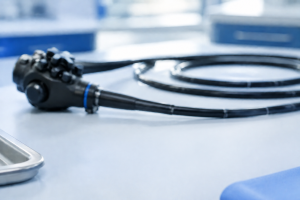
Free play at an endoscope control knob is a symptom, not a diagnosis. The movement can originate at the knob interface, brake mechanism, control shaft, pulley, angulation wire or farther down the bending system. Replacing the most visible control-body part before locating the lost motion can leave the original fault unchanged and can introduce new alignment problems.
This repair-engineering workflow shows how to separate those fault regions without assuming that one symptom identifies one component. Always follow the manufacturer’s service documentation and instructions for use (IFU). Only qualified personnel should inspect, dismantle, adjust or release an endoscope for service.
Define Free Play Before Opening the Control Body
Place the endoscope in the manufacturer-approved neutral test condition with the insertion section supported. Record how far the knob moves before the distal end begins to respond, whether the delay is the same in both directions, and whether the response changes when the brake is applied. Observe all permitted directions separately. “Loose knob” is too vague for a useful repair record.
Also record maximum angulation, return-to-neutral behavior, unusual friction and whether motion is smooth or stepped. A knob that feels loose while distal travel remains symmetrical suggests a different investigation from a system that loses travel in only one direction.
Inspect the External Knob and Brake Interfaces
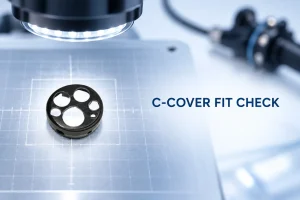
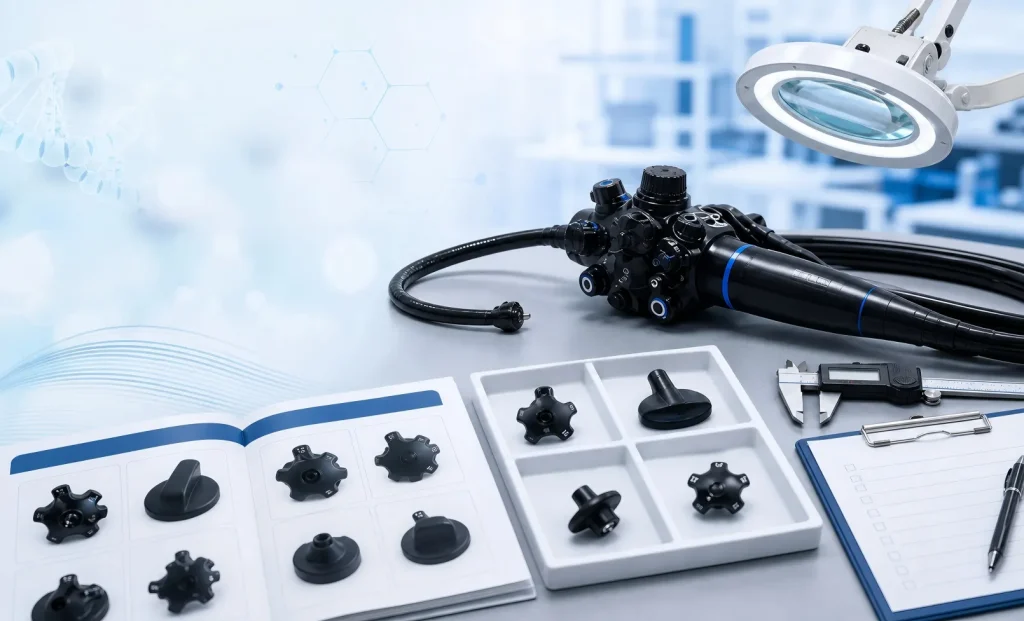
Before disassembly, inspect accessible knob surfaces, fasteners, stops and brake controls under suitable magnification. Look for cracks, deformation, impact marks, missing retention features and abnormal spacing. Compare the assembly with controlled model-specific references rather than a different scope that merely looks similar.
Operate the brake through its approved range while watching the relationship between knob input and distal movement. A brake that drags, slips or fails to release can change the technician’s perception of free play. Do not compensate by tightening an accessible fastener unless the service procedure specifies the torque, sequence and alignment method.
Separate Knob-Side Motion From Cable-Side Motion
Once the approved service procedure permits access, identify the input and output sides of the mechanism. Apply small controlled movements and observe where motion begins and where it is lost. If the control shaft moves but the pulley does not respond immediately, inspect the coupling and retention region. If the pulley responds but distal angulation is delayed, the investigation moves toward the angulation wire, anchoring points, coil pipe and bending section.
Evidence to Record
- Angular movement at the knob before pulley response.
- Pulley movement before distal-tip response.
- Difference between up/down and right/left systems.
- Brake position during each observation.
- Visible damage, contamination or displaced retention features.
- Maximum angulation and neutral return before adjustment.
Check the Pulley and Angulation-Wire Relationship
Lost movement downstream of the knob can be associated with cable stretch, damaged terminations, abnormal pulley engagement, displaced guides or bending-section resistance. These conditions can overlap. A stretched cable may produce delayed response, while a mechanically restricted bending section may cause high effort and incomplete travel. Do not treat both symptoms with the same adjustment.
Use only the manufacturer-approved tension or travel measurement. Pulling a cable by hand does not reproduce the installed load path and may damage it. If wire condition or termination integrity is uncertain, stop and follow the relevant model-specific procedure.
Consider the Coil Pipe and Bending Section
Control-body observations must be related to the distal mechanism. A compressed or displaced coil pipe, damaged mesh, distorted bending segment or incorrectly installed bending rubber can influence angulation load and neutral return. Inspect these regions when the evidence points downstream, especially when knob force rises near one part of travel.
Do not increase cable tension simply to overcome distal resistance. Excess tension may hide the original problem temporarily while increasing stress elsewhere in the system.
Decide Which Product Family the Evidence Supports
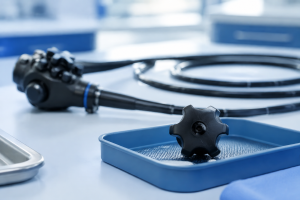
External knob or grip damage belongs to the control body parts investigation. Verified wire or termination faults point toward the angulation cable family. Distal mechanical damage may instead require inspection of the assembled bending section or related coil-pipe components. Compatibility must be confirmed against the exact model and controlled part reference.
Verify the Repair Under the Original Conditions
After an approved repair or adjustment, repeat the original free-play measurement with the same support, brake position and direction sequence. Confirm maximum travel, smoothness, neutral return and brake behavior. Complete required leak, functional and safety checks before release. A knob that feels tighter is not sufficient evidence of a successful repair.
FAQ
Does knob free play always mean the angulation cable is stretched?
No. Free play may originate in the knob, shaft, brake, pulley, cable, anchoring or distal bending mechanism. Isolate the location before selecting a part.
Can a technician remove play by increasing cable tension?
Only when the manufacturer’s procedure identifies adjustment as appropriate and specifies the method. Tension must not be used to mask damaged or restricted components.
What information is useful for a control-body parts inquiry?
Provide the exact model, controlled part reference when available, clear external photographs, the isolated fault region and required quantity. Use “compatible with” language until fit and function are verified.
Conclusion
Control-knob free play should be traced from input to output: knob and brake, shaft and pulley, angulation wire, coil pipe and bending section. That evidence-based sequence helps avoid replacing the wrong visible part. For a documented compatible-parts requirement, contact Endopart with the model, fault observations, photographs and quantity.